


Targeting Kingfish (King Mackerel) with High-Speed Vertical Jig Fishing Rod
The Fish That Cut My Leader in Half a Second
Nobody warns you about the sound.
Not the run. Not the drag. The sound a metre of fluorocarbon makes when it is dragged across the teeth of something that has decided, in a fraction of a second, that it would prefer not to be in your boat.
It is a short, sharp thwick — like a guitar string snapping — and then your line comes back with a clean diagonal slice in it and nothing attached to the other end.
That happened to me four times in one morning off a reef ledge in about 45 metres of water, and by the third one I was starting to take it personally. 🐟
The fourth time, I did something I had been too stubborn to do all morning: I put a wire bite tippet on the front of my leader. The very next drop got eaten so hard the rod nearly left my hands, and twenty minutes later there was a king mackerel on the deck that I would estimate at 18 kilos, with a mouth full of teeth I could have lost a finger in.
That morning is the reason I am writing this. Not because I am some kind of kingfish whisperer — I am emphatically not, and the four lost fish prove it — but because high-speed vertical jigging for kings is one of the most technically misunderstood games in offshore fishing, and almost every piece of advice I read before that trip was either too vague to act on or flatly wrong.
So let us fix that. Properly. With numbers.
First: Which "Kingfish" Are We Actually Talking About?
This matters more than it sounds, because the word means two completely different fish depending on where you are standing, and the gear advice is not interchangeable.
King mackerel (Scomberomorus cavalla), called kingfish across much of the US Gulf and Atlantic seaboard. A long, silver, laterally compressed scombrid with a lateral line that drops sharply below the second dorsal fin, and a mouth full of teeth that would embarrass a shark. They are fast, they are pelagic, and they eat with their teeth first.
Yellowtail kingfish (Seriola lalandi), called kingfish or "kingie" across Australia and New Zealand. A completely different animal — a Seriola, closer to amberjack than to mackerel. Yellow stripe down the lateral line, yellow tail, built for sustained speed and structure fighting.
Here is the crucial tactical difference:
|
King mackerel |
Yellowtail kingfish |
|
|---|---|---|
|
Family |
Scombrid (mackerel) |
Carangid (Seriola) |
|
First instinct |
Sprint horizontally, fast |
Dive vertically into structure |
|
Main threat to you |
Teeth |
Reef |
|
Leader priority |
Bite-proofing |
Abrasion-proofing |
|
Drag approach |
Moderate, or you pull hooks |
Heavy, or you get reefed |
One fish cuts you. The other reefs you. You rig for both, and you adjust the emphasis based on which one is actually in the water in front of you.
I am going to cover both, because if you fish anywhere with international traffic — or you read gear articles written on the other side of the world — you need to be able to tell which advice applies to you. 🎯
Why High-Speed Vertical Jigging Works So Well on Kings
Let me explain the mechanism, because once you understand why, the technique stops feeling arbitrary.
In slow-pitch jigging, the jig imitates an injured, fluttering baitfish sinking. Predators that eat that presentation strike lightly — they do not need to be aggressive to catch a dying fish.
In high-speed vertical jigging, the jig imitates a healthy baitfish fleeing upward. Something fast, strong, and about to escape. A predator that wants that meal has to commit violently, because hesitation means the meal is gone.
That is why the strike is different in character. Slow pitch gives you soft takes. Speed jigging gives you detonations.
And kings — both species — are built to exploit exactly that moment of panic. They are ambush predators that sit near the edges of bait schools and react to commotion. A jig ripping upward through the water column at the right speed is the single most triggering thing you can put in front of them.
There is a second, sneakier advantage. Speed jigging lets you search a huge amount of vertical distance fast. The water column is not one place. It is a stack of distinct zones — oxygen, temperature, bait, current — and kings hold at specific depths for specific reasons. Covering that stack systematically beats sitting on one depth hoping.
The Retrieve: The Numbers Nobody Gives You
Here is the part most articles skip. "Reel fast" is not advice. This is advice.
Retrieve-rate modelling for vertical jigging produces a useful species-specific table based on vertical climb speed rather than handle speed. Vertical climb is what the fish actually experiences:
|
Target |
Useful vertical speed |
Common cadence |
|---|---|---|
|
Tuna and pelagics |
3.0 to 6.0 ft/s (0.9 to 1.8 m/s) |
90 to 145 turns/min |
|
Amberjack and Seriola |
2.4 to 5.0 ft/s (0.7 to 1.5 m/s) |
75 to 125 turns/min |
|
Kingfish and mackerel |
2.2 to 4.5 ft/s (0.7 to 1.4 m/s) |
75 to 120 turns/min |
|
Grouper and reef fish |
1.6 to 3.4 ft/s (0.5 to 1.0 m/s) |
65 to 105 turns/min |
|
Cod and bottom fish |
1.1 to 2.5 ft/s (0.3 to 0.8 m/s) |
45 to 80 turns/min |
Note that kings sit below tuna in preferred speed. That is a real finding and it matters, because the default advice for speed jigging — crank as fast as humanly possible — is optimised for tuna, not for kings. Kings want bursts and a slightly more controlled climb.
Note also the footnote that comes with that data: wire trace adds a drag penalty. Which is exactly the trade-off I was wrestling with on that morning I lost four fish.
The angle trap
Here is the thing that ruins more speed-jigging sessions than any other single factor, and almost nobody talks about it.
Watch vertical speed, not just handle speed.
A fast crank with a 25-degree line angle can move the jig sideways and upward more slowly than a controlled cadence with better vertical alignment. The preferred vertical range before retrieve speed starts leaking sideways is roughly 10 to 18 degrees off plumb.
Once your line scope crosses about 30 degrees from vertical, stop. Reel in. Reset your drift. You are no longer speed jigging; you are dragging a jig sideways through water where no fish is looking.
And one more correction that catches people out: published reel inches-per-turn figures are measured with a full spool and light load. A deep drop, a partly empty spool, and a tight drag can reduce actual pickup by 8 to 25 percent. Your reel is slower than its spec sheet says it is, precisely when you need it most.
|
Reel class |
Typical IPT |
Best depth band |
|---|---|---|
|
Compact 5000 spinner |
31 to 37 in (79 to 94 cm) |
40 to 160 ft |
|
Offshore 10000 spinner |
38 to 45 in (97 to 114 cm) |
80 to 300 ft |
|
High-gear 14000 spinner |
48 to 55 in (122 to 140 cm) |
120 to 400 ft |
|
Narrow lever drag |
34 to 46 in (86 to 117 cm) |
120 to 450 ft |
|
Low-gear power reel |
22 to 32 in (56 to 81 cm) |
180 to 600 ft |
For kings in 30 to 100 metres, the offshore 10000 class is the sweet spot. Enough pickup to hit the speed window, not so much that the handle becomes impossible to turn under load.
The Four-Phase Stroke (And the Phase Everyone Botches)
Let me break the actual motion down, because "reel fast" produces a jig that swims in a boring straight line.
Phase one: the drop
Let the jig fall on a controlled, semi-slack line. Thumb lightly on the spool if you are on a conventional reel. Do not free-spool it wide open or you will get a backlash. Do not brake it so hard it takes forever.
Watch your line, not your reel. The moment your line stops falling, or twitches, or suddenly goes slack at an unexpected depth, that is a fish eating on the drop.
A huge percentage of speed jigging strikes happen on the fall, before you have made a single crank. Set the hook on that. Immediately. A fish that eats on the drop and feels nothing will spit the jig before you finish your next thought.
This is not a drill. Kings in particular will mouth a jig on the descent and follow it up. If you do not come tight, they lose interest.
Phase two: bottom contact or target depth
Whether you are hitting bottom or stopping at the depth where fish are marked, this is your start point. If you are working a wreck or reef, know exactly where the bottom is — count your line, watch the sounder, or use a line-counter reel.
The instant you reach bottom, engage. Do not let the jig sit. Do not pause to admire your technique. Engage and go.
Phase three: the burn — this is the strike window
Two things happening simultaneously, which is what takes practice.
The rod sweep. Rod tip starting low, around eight o'clock, drive upward in a powerful, accelerating sweep to around one or two o'clock. This is not a gentle lift. It is a stroke that loads the rod and physically rips the jig upward through the water.
The crank. While the rod sweeps upward, crank. Fast. Continuously. Maximum tension, so every inch of rod travel transfers into jig movement instead of being lost to slack.
The combination produces a jig that darts — accelerating upward, flashing its flank, then as you drop the tip back it flutters and flares for a split second before the next stroke rips it up again. That dart-and-flutter at speed is the trigger.
Phase four: the reset — where most anglers fail
The moment the rod tip reaches the top of the sweep, drop it back to the start position while cranking fast to swallow the slack.
This is the phase that kills sessions. People sweep up beautifully, then drop the tip slowly while barely cranking, and create a belly of slack line. The jig stops moving. The illusion dies. And when they sweep up again, half the stroke is spent just taking up slack instead of moving the jig.
Your reel hand has to be as fast as your rod hand. If you can hear or feel slack, you are too slow.
A useful drill: keep the jig "singing" — a continuous vibration you feel through the blank. The moment the vibration stops, you have slack, and you have lost the fish that was about to eat. ⚡
A concrete cadence to copy
|
Element |
Timing |
|---|---|
|
Sweep |
about 1 second, eight o'clock to one o'clock |
|
Cranks per sweep |
4 to 6 fast turns |
|
Drop and reset |
about 0.5 second, 3 to 4 fast cranks to take up slack |
|
Full cycle |
roughly 1.5 seconds |
|
Cycles per zone |
5 to 6, then change depth |
That is roughly twenty cycles a minute. It is a genuine athletic pace. If your forearm is not complaining after ten minutes, you are going too slow.
The Rod: Why an Extreme Fishing Rod Blank Matters Here
Now the tool. And I want to argue for something specific, because this is where I think most people buy wrong.
Speed jigging is brutally hard on blanks. You are loading and unloading the rod roughly twenty times a minute, for hours, often with a 250 g piece of metal on the end, in a moving boat. That is a fatigue test more than a strength test. And the blank property that survives it is not maximum power — it is recovery and fracture toughness.
This is where the goofish ocean assassin genuinely earns its place, and specifically where the solid nano blank construction matters.
What "solid nano" actually does
A carbon blank is not just carbon. It is carbon fibre sheets bound together by an epoxy resin matrix, and that matrix determines how much vibration gets absorbed versus transmitted, and how well the blank resists micro-cracking under repetitive load.
Nano-scale particles — silicon dioxide, carbon nanotubes, specialised ceramics — are integrated into that resin. Because of their enormous surface-area-to-volume ratio, they create a stronger, more uniform bond with the carbon fibres and improve the composite's fracture toughness: its resistance to crack propagation.
Two practical consequences for speed jigging specifically:
- Faster recovery. Less internal damping means the blank returns to straight faster after each stroke. At twenty cycles a minute, a blank that is even slightly sluggish in recovery costs you real jig movement on every single stroke. Over a session that is thousands of strokes.
- Fatigue resistance. Repetitive loading is exactly what causes micro-cracking in a resin matrix. Nano-reinforced resin resists it. This is the difference between a rod that feels the same in season three and one that goes quietly soft.
And the "solid" part — solid rather than hollow construction — allows a thinner overall diameter for the same strength. Thinner means less mass out at the tip, and mass at the tip is the enemy of everything you are trying to do. Custom builders have a rule worth memorising: a gram saved at the tip is worth several grams saved at the butt.
The 47kg test figure, decoded
The ocean assassin carries a listed 47kg test — about 104 lb.
Let me be precise, because this number gets quoted endlessly and understood rarely. A blank test is a static, worst-case measurement: rod clamped horizontally, load pulled perpendicular to the tip until something gives. It is not a deadlift figure. It is emphatically not a drag setting.
What it tells you is that the butt section has genuine reserve. For kingfish — yellowtail kingfish especially — that matters enormously, because their first instinct is a violent vertical dive toward the sharpest structure available, and you need a rod that will simply refuse to let its head come around.
Why this is the right jigging rod profile
|
Spec |
Value |
Why it suits kings |
|---|---|---|
|
Length |
6'4" (193 cm) |
Long enough to work over a gunwale; short enough to winch with |
|
Action |
Fast, top third |
Loads and unloads fast — essential at 20 cycles/min |
|
Power |
MH |
Sits in the PE 4 to PE 6 band kings are fished in |
|
Blank test |
47kg test |
Butt reserve for the first dive |
|
Max jig |
650 g |
Covers 150 to 400 g with room to spare |
|
Guides |
Titanium frame, SiC ring |
Light tip for recovery; heat shedding on long runs |
That fast top-third action is doing real work. Fast action gets you to the backbone of the blank faster, with just enough tip flex to allow the twitch-and-pause motion to work without so much flex that the line goes slack. That is exactly the balance speed jigging wants.
Is this an extreme fishing rod blank? In the sense that matters — yes. It is designed to be loaded hard, repeatedly, at high cadence, without complaint. That is a different brief from a delicate finesse rod, and it is the brief this rod was built to.
Is This the Upgrade Fishing Rod 2024 Actually Worth Making?
Let me be straight with you about where this sits, because I am not going to pretend it is a flagship.
Japanese flagship rods have genuine engineering advantages. Shimano's Spiral X Core integrates Toray Nanoalloy and is claimed to deliver up to 10 percent more torsional rigidity and 15 percent more compressional rigidity than standard Spiral X. Daiwa's X45 and 3DX kill blank twist under load. Both are real, measurable, and you can feel them when you twist a blank in your hands.
What you buy with that money is refinement: less twist, better weight distribution, longer warranty, better resale.
What you do not buy is a proportional increase in the thing that decides kingfish sessions — jig speed, recovery, and the durability to sustain a high cadence all day. Those are governed by tip mass, taper and resin behaviour, and the solid nano blank closes that gap hard.
At roughly US$398, with titanium-framed SiC guides and a published 47kg test, I think this is the upgrade fishing rod 2024 that makes sense for the largest number of anglers. And I say that as someone who owns rods at three times the price.
Also worth saying plainly: kings destroy gear. Between teeth, reef, and the sheer violence of the fight, rods get broken in this fishery. A rod you can replace without flinching is not a compromise here. It is a strategy.
The Full King Setup: Real Numbers
Right. The part you can actually copy.
Rod and reel
- Rod: goofish ocean assassin, 6'4", one piece, fast action, MH. A heavy tackle fishing rod that still has enough tip to work a 200 g jig properly.
- Spinning reel: 6000 to 10000 size, high gear ratio, sealed drag. A 4.8:1 or better retrieve with around 20 lb of usable drag covers a huge amount of king water.
- Overhead alternative: compact high-speed jigging reel. Direct line path gives a faster, more natural fall — relevant because so many eats happen on the drop.
- Why not bigger: a 14000 high-gear reel gives 48 to 55 inches per turn, which is fantastic at 120 to 400 ft and genuinely hard to sustain at king cadence in shallower water. Match the reel to your depth band, not to your ego.
Line
- Braid: 50 to 80 lb, 8-carrier, high quality. Zero stretch means immediate hook-setting power at depth and clean transmission of every signal.
- Go as thin as conditions allow. Thinner diameter cuts through current, which keeps your line angle inside that 10 to 18 degree window, which is what keeps your retrieve speed real.
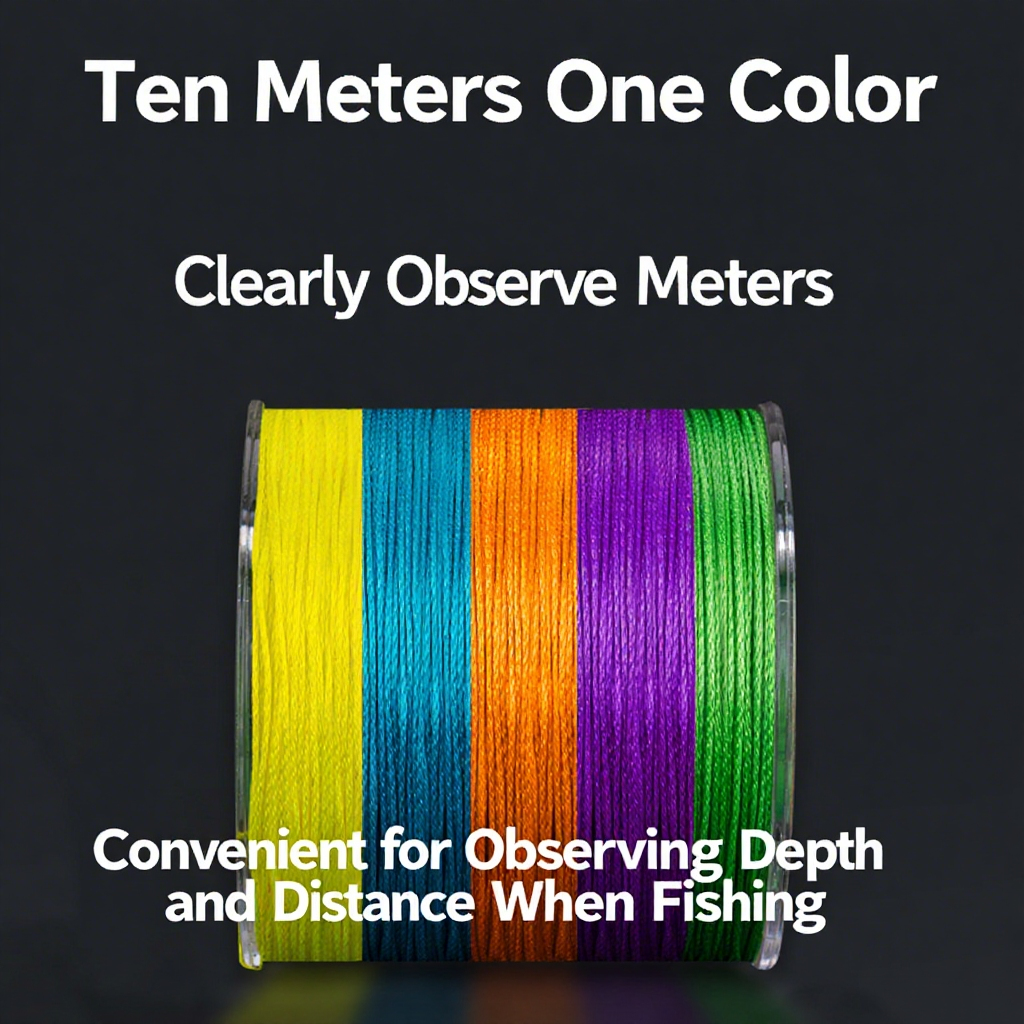
- Colour-metred braid is worth paying for. It lets you track depth and detect subtle strikes on the drop without guessing.
- Remember PE is a diameter standard, not a strength standard. PE 6 is 0.405 mm; actual break ranges from 80 to 90 lb depending on brand. Read the spool.
Leader — and this is where kings bite you
|
Situation |
Leader |
Reasoning |
|---|---|---|
|
Clear water, pressured fish |
40 to 60 lb fluoro, 2 to 2.5 m |
Visibility first |
|
General king jigging |
60 to 80 lb fluoro, 1.5 to 3 m |
Balanced |
|
Heavy structure, big yellowtail |
80 to 100 lb fluoro, 1.5 to 2 m |
Abrasion against reef and barnacles |
|
Any chance of king mackerel |
Add a short wire bite tippet |
Or you lose the fish in half a second |
That last row is the one I ignored for four fish. Do not be me.
A note on the trade-off: wire adds a drag penalty to your retrieve, and it is more visible. Use the shortest length that gets the job done — around 15 cm ahead of your fluorocarbon — and accept the small cost. Losing four fish costs more.
Connection
FG knot for braid to leader. Correctly cinched it retains around 90 to 95 percent of linear breaking strength and passes through the guides smoothly. Tie it at home in good light, never on a rocking boat at 5 a.m.
Jigs
- Weight: 150 to 250 g for most king water; up to 400 g in deep water or strong current. Match jig weight to conditions, not to arbitrary rules.
- Profile: knife jigs for fast sinking and tight action; butterfly and leaf profiles for slower fall and erratic flutter. Carry both.
- Colour: chrome, blue-white and luminescent finishes for deep reef work. Glow finishes at dawn and dusk.
- Hooks: assist hooks on heavy cord rather than fixed trebles. Sizes 5/0 to 7/0 for speed jig rigging. Twin assists on jigs over 200 g, single on lighter presentations to preserve action.
- Hardware: solid rings and heavy split rings rated well above your leader. Cheap split rings are false economy — failures at that connection cost you fish and expensive jigs.
Fighting the Fish: Two Species, Two Protocols
King mackerel — do not lock the drag
Here is the counter-intuitive one that took me years to accept.
Over wrecks and heavy structure, with grouper or amberjack, you lock the drag and winch. With king mackerel over open ledges and reefs, a locked drag will end up with a pulled hook or a break-off.
Kings have soft, toothy mouths and they run horizontally at enormous speed. Too much drag and you either tear the hook through or you shock the leader into failure. Fish a moderate drag — meaningfully lighter than you would for amberjack on a wreck — and let the fish run.
Then: get it up fast once you have control. Speed of retrieval matters, because a king can change direction and come back at you, and slack is how hooks fall out.
Yellowtail kingfish — the opposite
Yellowtail kingfish are notorious reef fighters. The moment they are hooked their instinct is to dive straight back into the sharpest structure available. Fish too light and you get reefed and lose your gear almost every time.
Standard advice for serious yellowtail kingfish work: a rod rated PE 5 to PE 8, a reel delivering 10 to 15 kg of smooth, heat-resistant drag, and in the toughest water 15 to 20 kg of stopping power. You apply maximum pressure from the first second.
Same word. Opposite protocol. This is exactly why the naming confusion at the top of this blog is not pedantry — it is the difference between landing the fish and losing it. 🎣
The Sounder Work That Actually Finds Kings
Speed jigging is a searching tool. Use it like one.
Do not just drop to the bottom. Drop to where the fish are marked. If you see fish at 40 metres on an 80-metre bottom, stop the jig at 40 and work up from there.
Work up through the school. Pelagics look up, not down. Fish are often caught a few feet above the depth you see on the sounder, because they have followed the jig upward before striking.
Watch the descent like your season depends on it. Many times a fish will pick up the jig on the way down. If the line speeds up or slows down during the drop, put the reel in gear and come tight. It may be a fish.
Chase the school. Kings are highly mobile. They may hold tight to a reef edge one day and roam several kilometres the next, following bait. Focus less on specific GPS marks and more on the factors that make marks productive: bait, current, and structure that concentrates both.
Work the edges, not the middle. Speed jigging is normally done near a wreck, reef or ledge — typically beside it, not directly over it. Structure hides baitfish; pelagics hang near it because that is where the food is.
Watch the thermocline. Kings concentrate where temperature breaks stack up against bait. Jigs worked just above the break generally out-fish jigs worked through it.
Mistakes I Have Made, Ranked by How Much They Hurt
In the interest of full disclosure. 💀
1. No wire trace. Four fish in one morning. Covered. Never again.
2. Locked drag on king mackerel. I lost a genuinely big fish by applying amberjack pressure to a mackerel mouth. Pulled the hook on the third surge.
3. Dropping to the bottom instead of to the fish. For a whole season I dropped to the bottom out of habit. Then I started stopping at the marked depth and working up, and my hookup rate roughly doubled. Kings live in the water column, not on it.
4. Cranking fast with a bad line angle. I was turning the handle at a genuinely athletic pace and catching nothing, because my line was 35 degrees off vertical and the jig was travelling sideways. Reset the drift. It feels like wasted time. It is not.
5. Not watching the line on the drop. I cannot count the number of kings that ate my jig on the descent while I was watching my reel, or the horizon, or my mate's rod. Watch the line.
6. Cheap split rings. One of the four fish I lost that morning was actually a straightened split ring, not a cut leader. I only found out when I inspected the jig.
The Complete King Speed Jigging Checklist
Print this. Tape it inside the locker.
Before you leave the dock
- [ ] Braid inspected, fresh, colour-metred
- [ ] Leader material matched to species and structure
- [ ] Wire bite tippet packed if there is any chance of king mackerel
- [ ] FG knot tied at home, tested
- [ ] Split rings and assist hooks upgraded to rated hardware
- [ ] Drag set with a spring scale, not by feel
On the water, every drop
- [ ] Watch the line on the fall
- [ ] Come tight instantly on anything unusual
- [ ] Rod tip eight o'clock to one o'clock, accelerating sweep
- [ ] 4 to 6 cranks per sweep, reel hand as fast as rod hand
- [ ] 0.5 second reset with 3 to 4 fast cranks
- [ ] 5 to 6 cycles per zone, then move
- [ ] Line angle inside 18 degrees. If not, reset the drift
Fighting
- [ ] King mackerel: moderate drag, let it run, then get it up fast
- [ ] Yellowtail kingfish: heavy drag from the first second, do not let it reach reef
- [ ] Check leader after every single fish
- [ ] Braid gloves, always
Final Word
High-speed vertical jigging for kings is not complicated. It is precise. There are maybe six variables, and every one of them is measurable: retrieve speed, line angle, cadence, jig weight, drag setting, and whether or not you put a wire trace on.
Get those six right and the fish will find you, because a jig darting upward through a bait school at the correct speed is close to irresistible. Get two of them wrong and you will have a lovely day on the water and nothing to show for it.
The heavy tackle fishing rod doing the work does not need to be the most expensive stick on the boat. It needs to recover fast enough to keep up with twenty cycles a minute, have enough butt to turn a fish that wants to go down, and be built to survive being loaded hard for season after season. The solid nano blank in the goofish ocean assassin does all three, and it does it at a price that lets you buy two.
Now go find some bait on the sounder, drop past it, and reel until your forearm complains. 🌊
Tight lines.
Frequently Asked Questions
What is the best jigging rod for kingfish?
For yellowtail kingfish, look for a rod rated PE 5 to PE 8, between 6 and 7 feet, with a forgiving fast tip and a very stiff lower section. For king mackerel you can go slightly lighter — PE 4 to PE 6 — because the fight is horizontal rather than a vertical dive to structure. A 6'4" fast-action MH rod with a 47 kg blank test covers both comfortably.
How fast should I retrieve when speed jigging for kings?
Kings and mackerel respond to a vertical climb of roughly 2.2 to 4.5 ft/s (0.7 to 1.4 m/s), which works out to about 75 to 120 handle turns per minute. That is slower than the cadence you would use for tuna. Bursts trigger chases.
Do I need a wire leader for king mackerel?
Yes, or you will lose fish. King mackerel have teeth that cut fluorocarbon instantly. A short wire bite tippet of around 15 cm ahead of your fluorocarbon leader is the standard solution. It adds a slight drag penalty to your retrieve, which is a price worth paying.
What drag setting for kingfish?
It depends which fish. For yellowtail kingfish around structure, run 10 to 15 kg of smooth drag, or up to 20 kg in the toughest water, and apply it from the first second. For king mackerel over open ledges, fish a lighter drag — a locked drag commonly results in a pulled hook or a break-off.
What size jig for kingfish?
150 to 250 g covers most king water. Go to 350 or 400 g in deeper water or strong current. Match jig weight to conditions rather than following a fixed rule, and remember that going thinner on your mainline is often more effective than going heavier on the jig, because line diameter drives drag in the water column.
Why do I keep losing kingfish right at the drop?
Because you are not watching your line. A large proportion of speed jigging strikes happen on the fall, before you make a single crank. If your line stops falling, twitches, or goes unexpectedly slack, come tight immediately — a fish that eats on the drop and feels nothing will spit the jig.
Is a solid nano blank worth it for speed jigging?
For this technique specifically, yes. Speed jigging loads and unloads the blank roughly twenty times a minute for hours, which is a fatigue test. Nano-reinforced resin improves fracture toughness and reduces internal damping, meaning faster recovery and better resistance to the micro-cracking that makes rods go soft over time.
What is your king setup, and which of the two fish are you actually chasing? Drop it in the comments — I read every one, and I will absolutely argue with you about drag settings. 😄





Leave a comment